
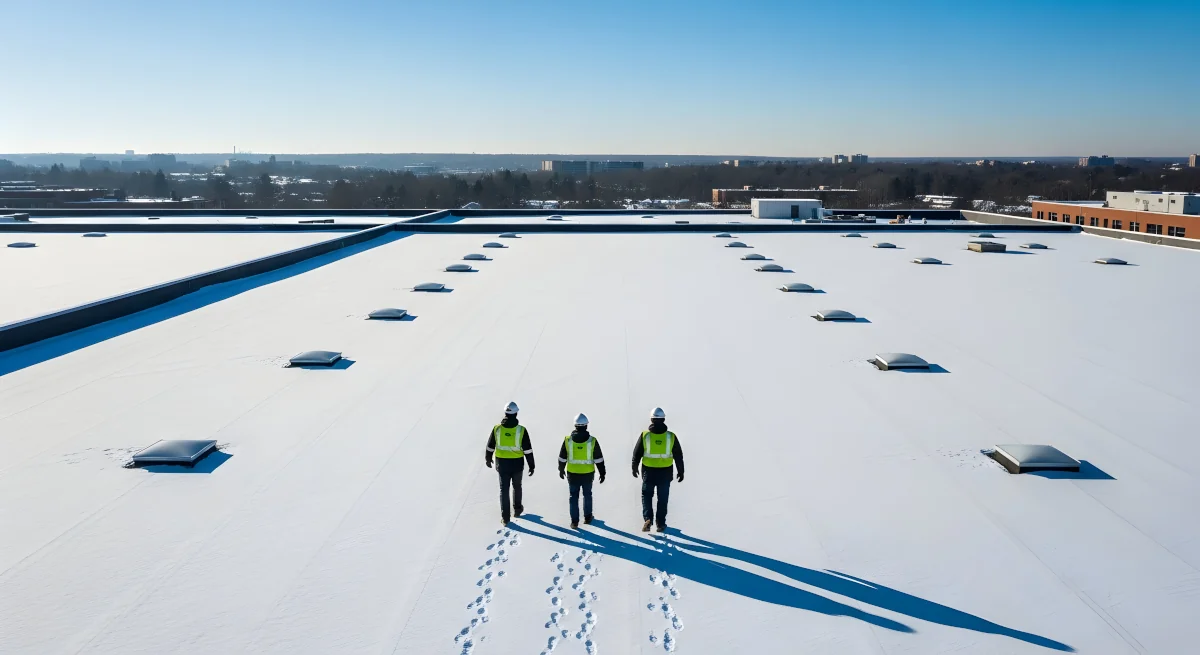
Winter weather is hard on every roof, but commercial flat roofs face a uniquely unforgiving set of challenges when snow arrives and temperatures stay below freezing for days or weeks at a time. Unlike pitched roofs that shed snow naturally, flat roofs hold it and everything that comes with it: weight, water, ice, and the stress of freeze-thaw cycles.
The January and February 2026 snowfall events that blanketed the Philadelphia region was a stark reminder of just how serious these risks can be. With 15 inches of dense, glacial-pack snow on the ground, weighing in at roughly 25 pounds per square foot, a building the size of the Pennsylvania Convention Center was holding over 21 million pounds of snow on its roof alone.
Most commercial buildings are engineered to handle regional snow loads, but engineering has its limits, and older buildings, deferred maintenance, and clogged drainage systems can push the limits of any roof and drain system.
This blog addresses the most common and most urgent questions we hear from commercial property owners after a major snow event. From understanding snow load thresholds and deciding whether snow removal is necessary, to diagnosing winter leaks, preventing ice dams, and evaluating your drainage system, we’ve highlighted some considerations to be aware of after a snow event.
If you would like a quote on commercial flat roofing in Phoenixville, commercial roof restoration in Philadelphia, flat roof repair in Wilmington, or any other flat roof service in the Delaware Valley, we are here to help.
1. Does snow affect flat roofs?
Yes, it absolutely does. The weight of snow on any flat roof can become overwhelming to the roof structure, depending on the amount of snow. For example, the snow that landed on Philadelphia January 26 of 2026 was considered a glacial pack snowfall; the snow was dense, and the area received 15 inches on average. The weight of that snow was approximately 25 pounds per square foot. To put things in perspective, the Pennsylvania Convention Center is an 871,000 ft building. The approximate weight of the snow that landed on that building was 21 million 775,000 pounds. Thankfully, engineers designed roofs with a combination of building materials, and they are designed to flex and move under load. The amount of the deflection on a roof in this part of Pennsylvania is rated for approximately 20 to 35″ of snow weight. (according to the IBC—Structural Code Development Committee in 2019 (Group B) Code Development Cycle). Ultimately, there is a difference between a cold, light snow and wet snow.
Another concern with snowfalls this time of year is the freezing temperatures. One thing that happens after a snowfall is that it drains on roofs and can potentially freeze and clog the gutter system leading to pore drainage, then any additional rain or snow will add more water and will be trapped on the roof, adding more weight to the roof.
In the past, roof and building collapses due to snow were often caused by improper design, poor maintenance, or the continuous accumulation of snow and water. Many affected buildings predate current structural safety codes. Formal regulations for load, wind, and material standards began developing in the early 1900s, with major updates following late 20th-century hurricanes. 50 years is a good rule of thumb if your building was built before 1975, it would be a good idea to have an engineer inspect the building.
Many commercial building owners will have a reputable commercial roofing contractor remove the snow, especially if the roof is over 50 years old and has an original wood beam system. As wooden beams get older and if they’ve been wet, they will rot and then split. If you see any sagging in any of your beams, you should definitely have your roof inspected and have the structural integrity of the roof inspected.
2. Should I have the snow removed from my flat roofs?
Yes, you should have the snow removed from your roof if it gets above a certain threshold. Snow weight varies heavily based on water content, ranging from 7 pounds per cubic foot for light, powdery snow to over 25 pounds per cubic foot for saturated wet snow, which presents a potential risk of structural compromise. Typically, buildings are engineered to withstand the expected snow load for their geographic region; however, evolving weather patterns may necessitate revisions to current building codes. So it is a good idea to have the snow removed from your flat roof when the sustained dense snow depth stays above 15 inches.
With that being said, there are several concerns about having your roof cleared of snow. Depending on the type of equipment used to remove the snow, the equipment can damage the roof depending on the type of roof material, including: spray foam, rubber, fiberglass-reinforced PVC, metal, and grass.
It is also important to know the age of your roof. Older roofs are more brittle and more easily susceptible to damage from snow removal equipment. It can and will poke holes in the roof, and unfortunately, you will not know that there is damage to the roof until the snow melts and reveals a leak.
Ultimately, it is a much better idea to have a professional inspect your roof and then have them remove the snow if they deem it necessary and if they are qualified, or if you are in weather conditions such as in the Northeast part of the country right now (January and February 2026) where the snow is not melting because it is so cold and then there is another snow event coming.
3. Does your roof have a skylight?
If your commercial flat roof has a skylight, consider the safety issue of invisible skylights buried under snow before letting someone onto your roof.
For example, some roofs have fiberglass skylights that may not be visible under the snow and may not have a safety rail around them.
Fiberglass is not structurally sound enough, and roofers get hurt every year by stepping on a skylight with no safety rails installed around it.
If you have skylights on your flat roof, talk to your roofer and either have the skylights removed or have safety rails installed around them. A professional will check the structural integrity of the roof support system as well.
4. Why is my flat roof leaking after snow and winter?
There are multiple reasons your flat roof could be leaking.
Weight of the Snow
Snow weight varies heavily based on water content, ranging from 7 pounds per cubic foot for light, powdery snow to over 25 pounds per cubic foot for saturated wet snow, which presents a potential risk of structural compromise.
The heavy snow causes the roof to sag slightly. This deflection could split seams on the roof material or pull the roof from the edge of the building, depending on what type of roof you have.
Temperature Change
But the larger threat to flat roofs is the temperature change. As a roof’s material gets colder, it gets more brittle.
Age of the Roof
Age is always a contributing factor. As roofs age they get more brittle, and as it gets colder the material gets brittle. An older roof has a harder time maintaining its elasticity in the cold, so if your roof is over 10 years old and you do not know what the warranty of your roof is, call a professional and have it inspected.
Heat Transfer
Another factor contributing to winter leaks is the process of heat transfer through the roof. If the building is snow-covered and not properly insulated, indoor heat melts the layer of snow in contact with the building.
If the gutter system is frozen, preventing drainage, this results in the formation of an ice dam. Ice will accumulate until external temperatures rise sufficiently to melt the dam.
Non-Temperature Controlled Buildings
The final common cause of leaks is temperature changes from a non-temperature controlled building causing the building to expand and contract.
Larger flat roofs have expansion joints because as the steel supporting the roof gets colder and the roof material gets colder, it shrinks, and then, as the building gets warmer, it expands.
Temperature Effects on Building and Roof Materials
Steel, wood, rubber, and other building materials expand and contract at different rates with temperature changes.
A flat roof can form a leak if the exterior temperature warms up too quickly that the building expands before the roof had a chance to expand with it. If the roof’s elasticity is compromised because of cold or age; it creates a failure point.
A professional roofing company will show you how this can be addressed.
5. What are Ice Dams and How Do I Prevent Them?
As described in the previous section, an ice dam is caused when freezing temperatures outside come into contact with the warmer surface of the roof, melting the snow and causing water to accumulate under the snow.
As the gutter system freezes, it prevents proper drainage; this process results in the formation of an ice dam. The freeze-thaw dynamics of ice will actually cause the ice to force its way under the roof material, and the ice will continue to accumulate until external temperatures rise sufficiently to melt the dam.
Ice dams form on all types of flat roofs, pitched roofs, and on all types of roof material. Some roofs handle it better than others, but the constant thawing and freezing of the ice will actually cause the ice dam to grow and travel up underneath the shingles of your pitched roof or the edges of your flat roof.
One of the best ways to not have an ice dam is to stop it from forming from the very beginning. There is a product on the market called heat tape that plugs into an electrical outlet and stays above freezing. You can run it inside gutters, inside downspouts, and on the edge of the roof where there are overhangs and things of that nature that make it easier to freeze. Talk to a professional to have some installed.
Always remember: safety first.
6. Types of Water Removal Systems
There are multiple types of water removal systems. Here are a few of the common ones; some do better with ice dams and some do not.
One of the best water removal systems for flat roofs is an interior drain. This system generally does not freeze because the heat from the building keeps the downspouts and the plumbing of the drains clear.
Another system is a gutter along the entire edge of the roof with downspouts in it; these systems tend to freeze severely in these weather conditions.
When temperatures are below freezing for weeks at a time, water removal systems with Scupper boxes have the same problem and can freeze worse and become a larger hazard for leaks. The downspout on the exterior of the building freezes and clogs, and then the water will back up into the Scupper box, freeze and expand and then split the Scupper box, at which point you may need a Scupper box repair.
Which leads to the next cause of leaks: as the water freezes it expands and then when it melts it retracts and then it freezes again and it expands and any hole or cavity in the roof will get larger and larger with the constant freezing and thawing. Not unlike how rocks and granite boulders for cracks and if water freezing and expanding is strong enough to split granite, then your roof will have no chance if water is trapped under the snow and then freezes.
Conclusion: Don’t Wait for a Leak to Take Snow Seriously
Snow on a commercial flat roof is never just a seasonal inconvenience; it’s a structural, safety, and liability issue that compounds quickly when temperatures stay low and the next storm is already on the way. The weight of saturated snow can stress even well-engineered buildings. Frozen drainage systems turn routine precipitation into standing water. Ice dams force their way under roof edges and membranes. And leaks triggered by winter conditions rarely appear until the snow melts; long after the damage has been done.
The good news is that most of these risks are manageable with the right information, the right professional, and proactive attention before problems escalate.
Whether your roof is brand new or decades old, a qualified commercial roofing contractor can assess your snow load risk, inspect for early signs of structural stress, clear snow safely without damaging your membrane, and help you build a drainage and prevention plan that holds up through the rest of winter and beyond.
Don’t wait until water is coming through your ceiling. If you have questions about your commercial flat roof, snow removal, ice dams, drainage systems, or a leak that appeared after the last storm, contact us today for a professional inspection. From flat roofing services in New Jersey to commercial roof restoration in Trenton, we’ll tell you exactly where you stand and what, if anything, needs to be done.







Add your first comment to this post